Home » Posts tagged 'Martyrs'
Tag Archives: Martyrs
The Apostles: Introduction
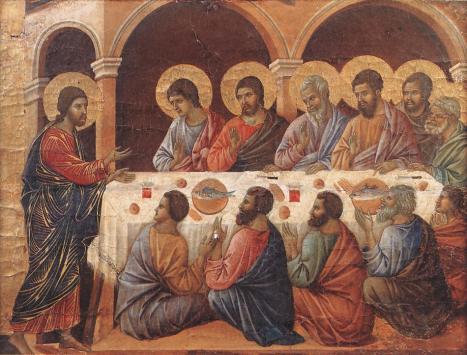
Who were the Apostles and what happened to them? Most people today know who Peter and Paul were, at least culturally if not through the eyes of faith. They may have heard of doubting Thomas or Judas (the one who betrayed Jesus), but what about the other Apostles? Who were they and what happened to them?
This will be the first part of a series on the Apostles of Jesus. For the introduction let’s start by looking at a common misconception that is generally touted against the Apostle nowadays.
There are some, mostly from the self-proclaimed “intelligentsia” who like to claim that the Catholic faith is made up. They say that it really was the ambitions of Paul who took Jesus’ message (if he even existed) and turned him into the god-man we know today. Ultimately it was just a profit making scheme, to make lots of money and exert control over the people or some other non-sense along those lines.
The very real problem with this poorly thought out theory are with the facts themselves. Let’s take a quick look at how each Apostle died:
The Original Twelve:
- Peter was crucified upside down.
- Andrew was crucified on an X shaped cross.
- John died a natural death.
- Philip was crucified by soldiers.
- Bartholomew was flayed and beheaded.
- Thomas was stabbed with a spear.
- Matthew was stabbed with a sword.
- James the Greater was stabbed with a sword.
- James the Lesser was stoned to death.
- Jude Thaddeus was shot with arrows.
- Simon the Zealot was crucified.
- Judas Iscariot committed suicide after betraying Jesus.
The Additional Apostles:
- Matthias was crucified.
- Paul was beheaded in Rome.
As we can clearly see, every single Apostle, with the exception of John died a very violent death. (And even then John faced persecution; being boiled, miraculously escaping, and later being imprisoned.) It would seem logical that these men were in it for more than just wealth and power. What man willingly dies for something he does not believe in? A man may be wrong about his beliefs and he may die for that wrong belief but he does not go willfully nor joyfully to his death as the followers of Christ had done.
They also gave up everything that they had, their livelihoods, their way of lives, everything to follow Jesus. They were sent to the farthest known corners of the Roman Empire and beyond. They went to Rome, Spain, Jerusalem, Egypt, Greece, Syria, and even all the way to Ethiopia and India.
None of them died rich, so if Christianity was some profit making scheme, it is obvious that it did not work out for them. They would have been much better off just being fishermen, instead of fishers of men. The Apostles all died without power or wealth or possessions, and guess what? They were only following their teacher, whom died in the same way.
And here is the kicker: People are still living and dying for this ancient faith. It is the one thing that just never seems to go away. As much as modern man would like to try and destroy the faith, or ignore it, or hate it, He still moves men and women today. Let us pray for those who are still be persecuted for the faith, and for the courage to prevail if we ourselves are put to the test. Let the example of the Apostles be our guide on how to live and die well for the faith.
For the rest of the series we will be exploring each Apostle: who they were, their relations to Jesus and each other, where they were sent to spread the Good News, and where their remains are located today.
Early Persecutions
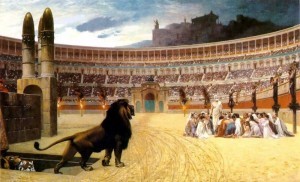
In A.D. 64 more than half of Rome burned to the ground. The Emperor Nero, blaming it on the Christians began the first major persecution of the Church by the State. These persecutions would last, on and off, till 313 A.D. with the Edict of Milan, which finally legalized Christianity.
Three particularly heroic martyrs of the early Church were St. Polycarp, St. Ignatius, and St. Lawrence.
St. Sir Thomas More
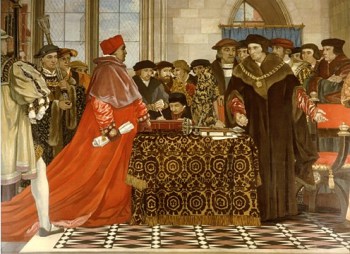
St. Sir Thomas More lived during the reign of King Henry VIII of England and Martin Luther, rebels, whom were major figures of the Protestant Rebellion. More worked tirelessly to halt the spread of Protestantism and was a staunch defender of the Church. In his work A Dialogue Concerning Heresies he asserted that the Catholic Church was the one true Church, whose authority had been established by Christ and the Apostles, and that its traditions and practices were valid.
 The Lord of History